Injury Science REU Research Projects
The Center for Injury Research and Prevention (CIRP) at Children's Hospital of Philadelphia (CHOP)'s Injury Science Research Experiences for Undergraduates (REU) Program offers projects across a range of research areas, including:
- Concussion and Brain Health
- Injury Rehab and Biomechanics Engineering
- Road Traffic Protection
- Violence Prevention
- Traumatic Stress
- AI in Healthcare Engineering
All REU students will be exposed to various aspects of the research process including problem-solving, data analysis, interpreting findings, and developing new research ideas. They will have opportunities to submit and present their work at conferences, including the Stapp Car Crash Conference, the Association for the Advancement of Automotive Medicine (AAAM) Annual Meeting, the Injury Biomechanics Symposium at The Ohio State University, the Annual Biomedical Research Conference for Minoritized Scientists, and the National Institute of Justice Research Conference, with support from their mentors and participate in the preparation of publications. Students will be encouraged to work independently with appropriate mentorship, to generate enthusiasm and future career interest in injury prevention.
CIRP is a leading multidisciplinary center engaged in collaborative cross-discipline research implementing real-world applications, and the Injury Science REU Program includes mentoring from a well-established team of highly trained pediatric researchers as well as peer mentors.
Applications for the 2027 REU Program open on December 14, 2026. Submit your application by January 13, 2027.
Watch a video about training opportunities with the Injury Science Research Experiences for Undergraduates Program:
Concussion and Brain Health Research Projects
- Project 1: Cognitive and Circuit Impairments Induced by Mild Traumatic Brain Injury
Mentor: Akiva Cohen, PhD
Research Description
Traumatic brain injury (TBI) is the leading cause of death and disability in children and young adults. A TBI occurs on average every 21 seconds and afflicts approximately two million people annually in the United States. No effective therapy currently exists to treat TBI. A profound obstacle to the diagnosis and treatment of TBI is the absence of an objective, quantitative test for TBI. The difficulty in diagnosing TBI is due in large part to the overlap in symptoms between TBI and other conditions (e.g., stroke, migraine, PTSD, depression and non-convulsive seizures), as well as variability in the initial injury and clinical presentation. Therefore, we are determining the nature of a brain circuitry functional biomarker in mice that have received a mild TBI.
REU Project Description
The REU student will become a member of the Cohen Lab at the Children’s Hospital of Philadelphia Research Institute. The student will receive mentorship from the lead investigator, as well as from members of his laboratory. The student will learn various behavioral paradigms and immunohistochemistry, as well as cell counting and biochemistry. The student will also gain experience in problem-solving, data analysis, interpreting findings, and developing new research ideas. There will also be opportunities to submit and present the student's work at conferences and to participate in the preparation of journal publications.
- Project 2: Optimizing Concussion Care for Children and Adolescents
Mentor: Dan Corwin, MD, MSCE
Research Description
The Minds Matter Concussion Research Program informs our leading concussion care at Children’s Hospital of Philadelphia. With a diverse patient population, we rapidly translate cutting-edge research into clinical care that advances target interventions, improves diagnostics, optimizes concussion treatment, and supports better long-term outcomes for pediatric patients. We have several ongoing projects that have supported our concussion care initiatives, specifically a project aiming to improve ensure consistent, high-quality care for concussion patients seen at diverse sites throughout the CHOP care network. The project investigates the effect of environment, geolocation and family factors that influence both access to care and risk for adverse outcomes. With this knowledge, we can better equip physicians, families, and communities with information about the differential risks after sustaining injury in specific settings.
REU Project Description
The REU student will work collaboratively with members of the CHOP Minds Matter Concussion team and gain exposure to a variety of research methodologies. Activities may include patient chart reviews, assistance with data coding/analysis, data management, and analyzing data from quantitative and qualitative data sources; leveraging natural language processing to enhance data capture; attending training activities and project team meetings; and presenting preliminary findings to internal and external partners. The student will also gain experience problem-solving research challenges and developing research ideas that suit those seeking a career in human subject research. This work may be completed on site or in the community. While the student will have opportunities for patient-facing experiences, this is not intended to be a clinical experience. Prior coursework in Public Health, Psychology, Social Work, Health Policy & Administration, Behavioral Health, Nursing, Health Sciences, Kinesiology, Statistics, or research methods is preferred, but not required.
Injury Rehab and Biomechanics Engineering Research Projects
- Project 3: Biomechanics in Automotive Safety and Rehabilitation Medicine
Mentor: Valentina Graci, PhD
Research Description
Motor vehicle crashes remain a leading cause of death for children, youth, and young adults. Historically, automotive safety research and advancements have focused on the mitigation of injuries once the crash has occurred. However, more recently automotive safety is switching its focus to studying ways to avoid crashes, such as Automated Emergency Braking (AEB). This technology provides a vehicle with the ability to stop automatically when an obstacle is detected. Since 2022 all new vehicles in the United States are equipped with AEB.
At the Center for Injury Research and Prevention at Children's Hospital of Philadelphia (CHOP)'s SLED Laboratory, we are interested in simulating different AEBs to understand how their decelerations influence occupant motion. Our team also collaborates closely with CHOP's Neuro-Motor Performance Laboratory (NMPL) and Division of Orthopedics to examine motor control and biomechanics performance in children with cerebral palsy and in adolescents who have undergone post-anterior cruciate ligament (ACL) reconstruction surgery.
REU Project Description
The REU student will become a member of the Injury Rehab and Biomechanics Engineering Research team at the Center for Injury Research and Prevention and will receive mentorship from several of the lead investigators of the Core. Depending on the stages of projects, the student will be involved in various aspects of the research process, including designing and machining experimental fixture, data collection on human volunteers, post-processing, data analysis, and interpretation of the results.
The student will develop skills with data analysis of a diverse set of data types that could potentially be: motion capture and EMG data collection and/or analysis of children and young adults. Previous experience using MATLAB, CAD, and Solidwork is critical. The student will have the opportunity to increase skills in this area. The student will also gain experience in problem-solving, analyzing data, interpreting findings, and developing new research ideas. There may also be potential opportunities to submit and present the student's work at conferences and to participate in the preparation of journal publications. This project work is on site to allow the student to also participate in potential data collection or fixture modifications, besides data analysis.
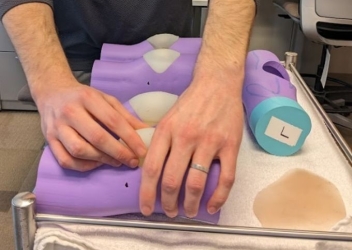
- Project 4: Developing a Family of 3D-Printed Anthropomorphic Models to Improve Clinical Training
Mentor: Elizabeth Silvestro, PhD
Research Description
Knee injuries are a common complaint among children presenting to emergency rooms and primary care centers. A common sign of knee injury is effusion, a collection of fluid that can be encapsulated or burst. Current diagnosis begins with a physical exam, which relies on a subjective interpretation of manual examinations. Medical training programs provide minimal hands on guidance with respect to accurately diagnosing pediatric knee effusions. At the same time, a misdiagnosis or delay in identifying knee effusions can impart longstanding complications to the joint, including growth disruption and loss of range of motion.
Because of this, MRI and ultrasound are currently used to provide clarity to the diagnosis, but this represents a significant increase in time spent in the clinic and includes a significant economic burden. Therefore, there is a need for a scalable solution to adequately prepare clinicians for manual pediatric knee evaluation. Hands-on trainers revolutionized training in cardiopulmonary resuscitation and offer an effective framework for improving manual diagnosis of pediatric knee effusions. The goal of this project is to design and develop 3D printed models of physiologic and pathologic pediatric knees for the purpose of training medical professionals.
REU Project Description
The REU student will become a member of the Additive Manufacturing for Pediatrics 3D Lab at CHOP. The student will be involved in various aspects of the research process, including data collection, data analysis, and interpretation of the results. The student will gain first-hand experience developing computational models, creating biofidelic models with 3D printing techniques, and performing mechanical testing with universal test frames.
The student must be enrolled in either a Bioengineering or Mechanical Engineering program. Previous experience with CAD programs, Finite Element Modeling, and coding with MATLAB and/or Python is desired but not required. The student will have the opportunity to increase skills in these areas and will also gain experience in problem-solving, data analysis, interpreting findings, and developing new research ideas. There will also be opportunities to submit and present the student's work at conferences and to participate in the preparation of journal publications.
Road Traffic Protection Research Projects
- Project 5: Analysis of Pediatric Occupant Kinematics and Kinetics in Motor Vehicle Crashes
Mentor: Jalaj Maheshwari, MSE
Research Description
Motor vehicle crashes and incidents are a leading cause of injury for children, youth, and young adults worldwide. The Road Traffic Protection Research team at the Center for Injury Research and Prevention strives to prevent these motor vehicle injuries through a variety of pediatric injury prevention research projects using computational modeling and/or sled testing. Human body models and anthropomorphic test devices (ATDs), also known as crash test dummies, are a great tool to assess the kinematic and kinetic responses of an occupant under different crash conditions. We are analyzing the responses of pediatric occupants involving different crash conditions, vehicle restraint parameters, and child restraints. The occupant kinematics, kinetics, and injury metric data will be analyzed over the crash conditions to better guide passive safety systems (seat belts, airbags) and child restraint system development.
REU Project Description
The REU student will become a member of the Road Traffic Protection Research team at the Center for Injury Research and Prevention and will receive mentorship from several of the lead investigators of the Core. The student will be involved in various aspects of the research process including data extraction, data pre-processing, data analysis, and interpretation of the results. The student will be analyzing kinematic, kinetic, and injury data.
Previous experience using MATLAB and/or Python is required. Additional experience with finite element (FE) modeling is desirable but not required. The student will have the opportunity to increase skills in these areas. The student will also gain experience in problem-solving, data analysis, interpreting findings, and developing new research ideas. There will also be opportunities to submit and present the student's work at conferences and to participate in the preparation of journal publications.
Violence Prevention Research Projects
- Project 6: Firearm Safety in the Hospital Inpatient Setting: Preparing for a Pragmatic Cluster RCT
Mentor: Katelin Hoskins, PhD, MBE, CRNP
Research Description
The rate of firearm-related deaths rose by 41% from 2018-2021 across all intents, making firearms the leading cause of death for youth ages 1-19. Secure firearm storage is critical for reducing unauthorized access to firearms and the risks of suicide, homicide, and unintentional injuries. Our NIH-funded study, Uniting Pediatric Nurses as Leaders In Firearm injury prevention: a hybrid Trial (UPLIFT), aims to reduce firearm-related deaths in children by implementing an evidence-based secure firearm storage intervention. The S.A.F.E. Firearm intervention consists of (1) a brief, parent-directed discussion on secure firearm storage using a harm reduction approach and (2) offering free cable locks to all parents during well child visits in pediatric primary care.
Notably, S.A.F.E. Firearm has the potential to save lives beyond primary care settings. Implementing firearm safety interventions during hospital admissions is a major opportunity to promote health, especially for children who are disproportionately at risk for and affected by firearm violence. In early phases of our study, we adapted S.A.F.E. Firearm for the pediatric inpatient setting and nurse-led delivery. We will subsequently conduct a pragmatic randomized control trial (RCT) across two CHOP hospitals to evaluate effectiveness of the adapted intervention in improving parent-reported secure firearm storage, and other secondary safety outcomes; the trial is slated to begin in late 2026. This work is at the forefront of firearm injury prevention and implementation science, with significant potential to impact public health both in Philadelphia and nationwide.REU Project Description
The REU student will join the UPLIFT study team, which includes investigators with expertise in firearm injury prevention, implementation science, biostatistics, and pragmatic RCTs. This opportunity offers unique exposure to fast-paced, applied implementation research within a learning health system. The REU student will be involved with analyzing data from our pilot work, finalizing intervention adaptations, and prepping our implementation blueprint for use in the RCT. The student also will be exposed to pragmatic cluster clinical trial design, an approach frequently used for rigorous evaluation in implementation research. In addition, the student will acquire skills in REDCap survey design, brief literature reviews and synthesis, and interprofessional communication.
Traumatic Stress Research Projects
- Project 7: Community-Based Approaches to Black Maternal Health and Postpartum Support
Mentors: Rachel K. Myers, PhD, MS; Ola Kalu, PhD, EDS
Research Description
Maternal morbidity and mortality remain a critical public health crisis in the United States, with Black women experiencing rates three to four times higher than White women. While community-based doula care has shown promise in improving perinatal outcomes and reducing gaps in outcomes across racial groups, less is known about how neighborhood conditions and institutional partnerships shape doulas’ capacity to provide consistent, high-quality care.
This project investigates how community health systems can better support doulas and postpartum families through community-informed care models. In collaboration with CocoLife Black and the Children’s Hospital of Philadelphia, the study examines structural factors affecting doula well-being and practice while documenting the implementation of postpartum support programs. By bridging research and practice, this work aims to identify strategies that strengthen community–clinical partnerships and advance maternal health for Black families.
REU Project Description
The REU student will become a member of the Community Violence Prevention (CVP) research team at the Children’s Hospital of Philadelphia, whose multidisciplinary work spans community-partnered research, trauma-informed programs, and family and youth health outcomes in clinical, school, and neighborhood settings. The student will receive mentorship and collaborate with academic and community partners studying how community partnerships and neighborhood contexts influence maternal and family health outcomes.
The student will contribute to a qualitative research project exploring postpartum care experiences and doula well-being within community-based maternal health programs in Philadelphia and Delaware County. Activities will include qualitative data coding and analysis, memo writing, literature synthesis, and preparing data visualizations or summaries for dissemination. The student will also participate in research meetings with academic and community collaborators, gaining exposure to participatory and trauma-informed qualitative methods.
This experience will build foundational skills in community-engaged qualitative research, maternal and family health improvement, and translating findings into public health practice. Prior coursework in Public Health, Sociology, Psychology, Social Work, Health Policy, or related disciplines is preferred but not required.
AI in Healthcare Engineering Research Projects
- Project 8: Applied data engineering: Using machine learning to analyze COVID-19 genetic data
Mentor: Scott Haag, PhD
Research Description
This project involves a collaboration between computational scientists and medical researchers at the Children's Hospital of Philadelphia (CHOP) to tackle the computational challenges of tracing and tracking the SARS-CoV-2 virus variants. The team, including Scott Haag, PhD, a computer scientist with the Arcus team and a faculty at Drexel University department of Computer Science, and researchers Paul Planet, MD, PhD and Ahmed Moustafa, PhD both faculty at the University of Pennsylvania and Co-director(s) of the CHOP microbial ARchive and Cryo-collection (mARC), PennCHOP Microbiome Program. The work will be focused on developing innovative algorithms to manage and analyze the vast amounts of genetic data associated with the COVID-19 virus.
REU Project Description
The REU student will become a member of the Arcus Applied Data (ADS) Science Team at the Children's Hospital of Philadelphia (CHOP). ADS is dedicated to harnessing the power of data science and analytics to improve pediatric healthcare outcomes. This team focuses on applying advanced data science techniques, including machine learning, predictive modeling, and big data analytics, to uncover insights from vast amounts of clinical and research data. By collaborating with clinicians, researchers, and healthcare professionals, the Arcus team develops innovative solutions that enhance patient care, optimize hospital operations, and contribute to groundbreaking research in pediatric medicine.
What would a student learn: As a member of the ADS team (Children's Hospital of Philadelphia), a student would gain hands-on experience in leveraging data science techniques to address real-world healthcare challenges. They would learn to apply statistical analysis, machine learning algorithms, and data visualization tools to analyze complex datasets, ultimately contributing to projects aimed at improving patient care and outcomes. The intern would work alongside experienced data scientists, gaining insights into the entire data pipeline from data collection and cleaning to model development and validation. Additionally, they would be exposed to collaborative research environments, honing their skills in interdisciplinary communication, problem-solving, and the ethical considerations of working with sensitive health data. This experience would prepare them for a future career in data science, particularly within the healthcare sector.