Research In Action
Research In Action

Rearward-facing child restraint systems (CRS), commonly called infant car seats, are designed to protect child occupants during a crash. While many infant seats are used with a detachable base, some can also be installed directly into a vehicle using the seat belt. Installation without a base can be particularly useful when travelling in taxis, rideshare vehicles or rental cars. But when installing a car seat without its base, does it matter how the seat belt is routed?
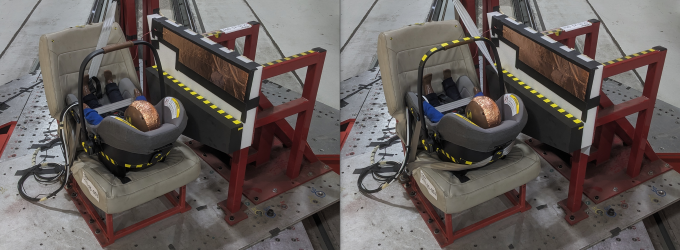
Our previous study published in Traffic Injury Prevention in 2024 provided an important clue. We tested rear-facing infant car seats installed without a base in the second-row middle seat of a vehicle, directly behind the center console. We found that the way the seat belt was routed changed how the car seat moved during a crash. The European belt path, which wraps the shoulder seat belt around the back of the car seat, produced less forward movement and prevented the car seat from hitting the center console. It also resulted in lower head and chest injury measures than the US belt path, in which the shoulder belt lays flat against the vehicle seat. These findings suggested that the European belt path could provide an advantage in a pure frontal crash, but crashes do not always happen head-on.
That led to our new study recently published in Traffic Injury Prevention, which investigated what happens when the collision is angled. Frontal-oblique crashes are relatively common and introduce sideways forces that can cause a child and their infant car seat to move differently than they would in a pure frontal crash. We wanted to understand whether the differences we had previously observed between the US and European belt paths would remain the same, or potentially change, when the collision is angled.
We conducted 12 sled tests using two rear-facing infant car seats and a crash-test dummy representing a 12-month-old infant. The tests simulated three types of frontal-oblique crashes: 30° far-side impact, 30° near-side impact and 60° near-side impact. We measured how far the car seat moved forward and sideways, as well as several established head and chest injury measures.
Overall, the research shows that how an infant car seat is installed can substantially influence how it moves during an oblique crash. The European belt path limited forward movement and was associated with lower head injury measurements in the 30° impacts, while the US belt path produced greater forward movement. Although head and chest injury measures were lower than with the European belt path in the 60° tests, the US belt path allowed the infant car seats to move substantially farther forward. In a real vehicle, this could increase the likelihood of the seat or child interacting with the front-row seatback or other vehicle structures. Because the laboratory setup did not include a front-row seat, the potential head and chest injury measures associated with the US belt path may have been underestimated. We concluded that further full-vehicle crash testing is needed to understand how these different movements interact with real vehicle interiors.