Research In Action
Research In Action
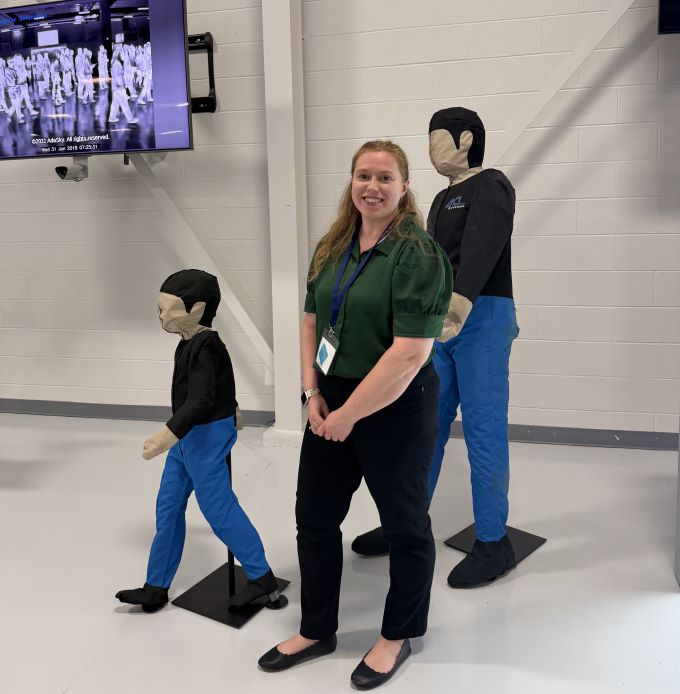

Pedestrian Automatic Emergency Braking, often called PAEB, is one of the latest evolutions of advanced in-vehicle technologies developed in recent years. As a crash-avoidance system that automatically applies the brakes when a pedestrian collision is imminent, its goal is simple and powerful: help prevent crashes between vehicles and pedestrians or reduce the severity of pedestrian crashes that cannot be fully avoided. Many new vehicles are equipped with PAEB, and the National Highway Traffic Safety Administration (NHTSA) will require it in all vehicles built after September 1, 2029 with a gross vehicle weight rating of 10,000 pounds or less (passenger cars are included within this weight limit).
Why Pedestrians Are Especially Vulnerable
PAEB is especially important because pedestrians are among the most vulnerable people on the road. Unlike vehicle occupants, pedestrians do not have seatbelts, air bags, or the protective structure of a vehicle to protect them and manage energy in a crash. The pedestrian is far more exposed to injury when struck by a vehicle. For this reason, technologies that help drivers avoid or reduce pedestrian crashes represent a major step forward in road safety.
Exploring Unintended Consequences For Vehicle Occupants
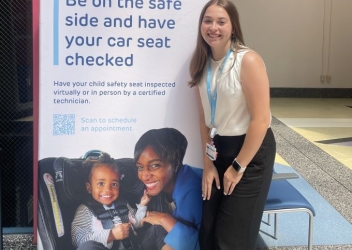
As vehicles become better at protecting road users outside the car, we also need to pay attention to how new countermeasures affect the protection of people inside the car. This has been the goal of our research in the Sled Laboratory since 2019. With the support of the Insurance Institute for Highway Safety, we were able to dive into characterizing PAEB braking responses in several scenarios for a variety of vehicles, representing a first step to understanding the braking accelerations to which vehicle occupants are subjected during PAEB responses. This work was recently published in the SAE International Journal of Transportation Safety and presented at the International Technical Conference on the Enhanced Safety of Vehicles in Toronto, Canada last month (co-author Maitland Witmer at the conference is pictured above).
We analyzed over 8000 vehicle braking responses during PAEB from controlled testing performed by the Insurance Institute for Highway Safety. We noticed that in some cases, PAEB creates very abrupt braking events. These sudden stops help avoid a collision with a pedestrian or reduce harm to the pedestrian in case the impact occurs, but also create unexpected movement for occupants inside the vehicle. Considering that children are already prone to odd postures in vehicles, these abrupt stops warrant further investigation. While occupants’ motion during PAEB may not necessarily be dangerous, they need to be studied so that safety systems can continue to improve for everyone.
Furthermore, there may still be atypical circumstances in which PAEB may not be able to avoid a crash (see articles here and here). In those circumstances, the occupants’ displacement caused by automatic emergency braking may reduce the restraints’ (i.e. seat belt) effectiveness in the subsequent crash. Understanding these effects is important to ensure that seat belts, air bags, and other occupant protection systems can effectively accommodate occupant movement during abrupt automatic braking responses.
Helping PAEB Reach Its Full Safety Potential
This research fills a gap in understanding how PAEB, despite its clear benefits for pedestrian safety, may influence occupant position in ways that interact with the performance of established occupant protection systems like restraints and air bags. Pedestrian protection and occupant protection should not be viewed as competing goals; rather, safety technology should be continuously examined for potential unintended consequences. Although those consequences may be unlikely, when they occur, they may influence the consumers’ acceptance of the value of vehicle safety advancements.
The overarching aim of our research is to help ensure that PAEB technology reaches its full potential in reducing harm to pedestrians while keeping vehicle occupants safe and well protected. Advancing road safety will require ongoing attention to both outcomes as crash avoidance technologies continue to develop.