Research In Action
Research In Action

Another crisp October is upon us, and once again, we recognize Domestic Violence Awareness Month. Each year, we come together to raise awareness, advocate for survivors, and work toward ending domestic violence. Yet intimate partner violence (IPV) continues to impact millions of individuals and families, with healthcare systems encountering its devastating consequences every day.
While IPV is often considered an adult healthcare issue, it is also a pediatric healthcare issue. Pediatricians are uniquely positioned to support caregivers and families, even when the child is our patient. Recognizing IPV and connecting survivors with resources are essential, but equally important is ensuring these opportunities are offered equitably.
Universal Education: Are We Truly Reaching Everyone?
Nearly 15 years ago, Children's Hospital of Philadelphia (CHOP) established STOP IPV to address IPV within pediatric healthcare. Through partnerships with local domestic violence agencies, including Lutheran Settlement House and Laurel House, the program provides direct survivor support, universal education, provider training, and institutional policy guidance.
A cornerstone of STOP IPV is universal education. At CHOP, we recommend offering IPV education and resources to all eligible adult caregivers presenting with their children, when it is safe to do so. Unlike traditional risk-based screening, which focuses on identifying individuals experiencing IPV, universal education provides information and resources regardless of perceived risk or disclosure.
The goal is simple: Everyone should have the same opportunity to receive information and support.
But what happens when a universal program isn't actually reaching everyone equally?
Through our quality improvement efforts, we identified several disparities in the delivery of IPV universal education. Caregivers of Black pediatric patients were more likely to be offered IPV education than caregivers of white pediatric patients, and female caregivers were more likely to receive education than male caregivers. Additionally, when IPV education was not offered, providers were less likely to document the reason for deferring education among caregivers of Black pediatric patients compared to those of white pediatric patients. Despite having a standardized policy, disparities persisted. We wanted to understand why.
Understanding the Role of Provider Bias
In 2024, our team published a mixed-methods study examining the role of race in IPV education within our pediatric emergency department. We explored how providers' assumptions, experiences, and beliefs might influence their decisions to offer education. Building upon these findings, we recently published a second study developing a contextual framework to better understand the underlying factors contributing to provider bias.
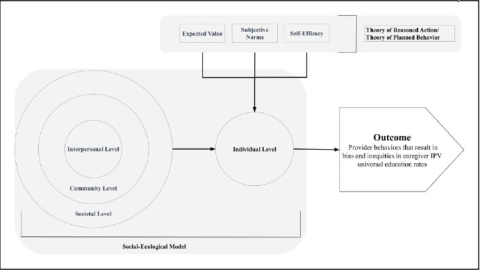
Using the Social Ecological Model and Theory of Planned Behavior, we examined how societal norms, organizational influences, personal experiences, and individual confidence shape clinical decision-making.
Our findings highlighted several important influences:
Societal stereotypes matter. Providers sometimes associated IPV with certain populations based on race, gender, or socioeconomic status. For example, some believed male caregivers were less likely to experience IPV and therefore placed less importance on offering them education.
Previous experiences influence behavior. Providers' interactions with caregivers could reinforce assumptions about who might benefit from IPV education. A negative experience offering education to one caregiver could influence whether a provider offered it to someone else.
Confidence and comfort play an important role. Some providers expressed discomfort discussing IPV or uncertainty about responding to a disclosure. This lack of confidence could influence their willingness to initiate conversations, particularly with caregivers they perceived as more likely to disclose violence.
Importantly, these influences can exist even when providers understand and support institutional policies recommending universal education. Having a universal policy does not automatically translate into equitable implementation.
From Research to Action: Advancing Equitable Care
Our research provides more than an explanation for why disparities occur. It offers a framework for identifying opportunities to address them. Within STOP IPV, we have used these findings to strengthen our standardized provider education by explicitly addressing implicit and explicit biases, challenging stereotypes about who experiences IPV, and helping clinicians recognize how their own experiences may influence clinical decisions.
Equally important is building providers' confidence in responding to IPV disclosures. Training should not simply emphasize the importance of offering universal education; it should also prepare clinicians to respond compassionately and effectively when a caregiver requests help, no matter the sex, gender, or race of that person. Therefore, we also continue to integrate diverse survivor perspectives into our training to challenge common misconceptions about IPV and reinforce that it can affect individuals across all backgrounds.
These findings also reinforce the importance of continuously evaluating our programs. Even well-established, standardized interventions require ongoing monitoring to identify disparities and ensure that our intentions translate into equitable care.
Other healthcare institutions implementing universal programs can similarly examine whether their policies are being applied consistently and identify opportunities to improve equitable access to care.
As we recognize Domestic Violence Awareness Month, I am reminded that awareness alone is not enough. We must also recognize how our own assumptions, experiences, and institutional practices may unintentionally create barriers to care. Healthcare systems have a responsibility not only to establish policies that promote equity but also to examine whether those policies are achieving their intended goals.
My hope is that we continue moving toward healthcare environments where every caregiver, regardless of background or circumstances, has an equitable opportunity to domestic violence education, support, and resources.