Research In Action
Research In Action

Thirty years ago, an IRB chair reviewing my injury research asked, “Why would someone study accidents?” The question captured the prevailing view that crashes were random misfortunes, largely beyond the reach of science. We now know the opposite: crashes have patterns, mechanisms, measurable precursors, and opportunities for prevention.
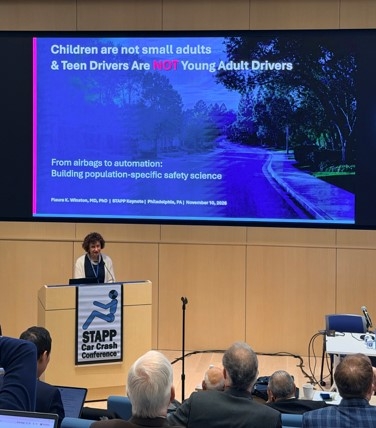
That change in thinking helped transform child passenger safety. In my keynote at the 70th Stapp Car Crash Conference, thirty years after I first brought cases of child deaths from passenger airbags to this community, I argued that the same population-specific approach is urgently needed for young novice drivers in vehicles with increasingly advanced automation. The central lesson is simple: safety science must begin with the people we intend to protect, not with the technology we have already built.
From a survivable crash to a field-wide response
In 1995, a child arrived at Children’s Hospital of Philadelphia after an otherwise survivable crash. The child had been properly restrained in a rear-facing child restraint in the front passenger seat, which was considered appropriate at the time. The adult driver survived. The child did not. The passenger airbag, designed around adult occupants, created a fatal mechanism.
The failure was not simply a defective device. It was a failure to ask who the occupant was. Early safety systems were developed and evaluated largely around adults, especially adult male body size and geometry. Children differ in anatomy, body proportions, skeletal maturity, restraint fit, posture, and injury tolerance. They are not small adults, and an adult-centered system cannot simply be scaled down and presumed safe.
The cases prompted a new scientific question: What protection does this child need at this developmental stage in this crash environment? Once the child became the subject of the science, rather than an adaptation problem, the research methods, engineering requirements, products, standards, recommendations, and communication changed.
Building the evidence system
No single discipline could answer that question. Epidemiology showed who was injured, how often, under what circumstances, and whether a problem was isolated or consequential. Detailed crash investigation reconstructed what happened among the child, restraint, vehicle, seating position, and crash forces. Biomechanics explained how loading and kinematics produced injury. Engineering identified where the pathway could be interrupted.
This integration is what I call biomechanical epidemiology: population evidence identifies the pattern, and biomechanics explains the mechanism. Neither is sufficient alone. Epidemiology without mechanism may not reveal the right design solution. Biomechanics without population context may not establish frequency, priority, disparities, or real-world effectiveness.
It also became clear that the child restraint is not an isolated product. It is part of a system that includes the child, caregiver, vehicle, restraint, and crash environment. A technically effective product can still fail when selection, fit, installation, compatibility, or the broader use system is ignored.
Science is necessary, but not sufficient
The child passenger safety story was not completed when the science was published. Evidence saved lives only when it changed products, testing, standards, policy, clinical guidance, public understanding, and behavior. Families and clinicians contributed lived experience and feasibility. Engineers and manufacturers brought design constraints and pathways to products. Government and standards organizations translated evidence into testing and regulation. Advocates and communicators created reach and trust.
Translation was not a final step. It was a pathway: observation, mechanism, population evidence, countermeasure, testing, standards or policy, implementation, and evaluation. The feedback loops mattered. Adoption did not automatically mean impact, so we had to continue measuring correct use, reach, unintended consequences, equity, and injury outcomes.
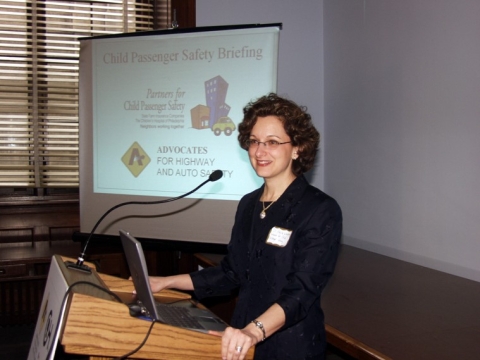
In 2003, I presented at a Senate briefing on changes to the Federal Motor Vehicle Safety Standards on Child Restraints.
Young novice drivers are not simply young adult drivers
The same adult-centered assumption now appears in a different form. Licensure can create the appearance of adult driving capability, but young novice drivers are a heterogeneous population, and most are still developing important driving capabilities when independent driving begins. Their readiness varies across experience, attention, hazard anticipation, emotional regulation, and performance in complex situations. That variability, rather than age alone, should be visible in safety science, design, and testing.
The traditional story has often framed teen crashes primarily as reckless behavior. Risk-taking matters, but that explanation is incomplete. Serious novice-driver crashes also reflect inexperience, inadequate scanning and hazard recognition, speed selection, distraction, and difficulty managing complex situations. Many errors occur before steering or braking: the novice does not yet know where to look, what a cue means, what may happen next, or which response fits the developing situation. In that sense, many novices are not careless; they are still building the mental library that experienced drivers use to recognize hazards early.
Experience changes what a driver sees, not merely how confidently the driver acts. Readiness is therefore multidimensional. It includes knowledge, perception, attention, executive function, emotional regulation, vehicle control, supervised experience, and performance under complexity. No single age, practice-hour requirement, road test, or behavior fully captures it.
Measure readiness before risk peaks
The supervised learner period offers an unusually important prevention window. Crash risk is low while an adult provides a safety net, then rises sharply at independent licensure. The goal should not be simply to accumulate hours. It should be to build meaningful experience and identify the skills or situations that need further practice before the protective supervision disappears.
The Virtual Driving Assessment is one approach to making crash-relevant performance visible. In about 15 minutes, it safely exposes drivers to serious crash scenarios, measures critical errors using standardized automated scoring, and provides personalized feedback. Its purpose is not to predict with certainty whether an individual will crash. It is to add objective information about readiness so practice, counseling, and support can be more precise.
Automation changes the human factors problem
Advanced driver assistance and automated-driving technologies do not eliminate the human factors problem. They change it. Driving may shift from continuous control to supervisory control, introducing new demands involving monitoring, expectations, engagement, mode awareness, and recovery.
A takeover request is not one action. The driver must notice an alert, orient to the roadway, rebuild situation awareness, understand the system’s limits, identify the hazard, select a response, regain physical control, and stabilize the vehicle. Experienced drivers bring richer hazard schemas, practiced recovery responses, and more calibrated expectations. Young novices may bring fewer of these resources, while also being vulnerable to distraction, mode confusion, misuse, or over-trust.
These are testable hypotheses, not reasons to exclude young drivers from technology. The research question is: under what designs, conditions, training, and safeguards can young novice drivers use automation safely? We need age- and experience-specific research on takeover performance, occupant kinematics during handoff, distraction and re-engagement, interface design, misuse and over-trust, simulation-to-road validity, crash and near-crash surveillance, and age-appropriate testing and standards.
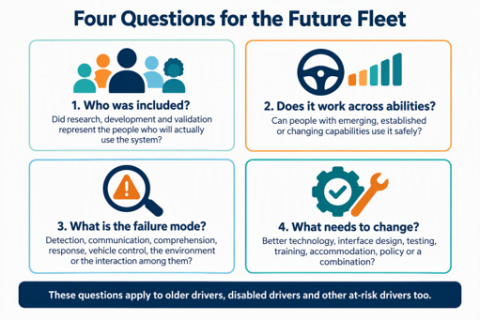
Researchers, automotive engineers, regulators, technology developers and injury-prevention practitioners can start with four practical questions.
Make young novice drivers visible before deployment
The history of airbags taught us not to wait until preventable deaths become the post-market test of adult-centered technology. Young novice drivers should be included early enough to shape research questions, scenario development, simulation, interface requirements, validation, testing, and standards, not added later as an accommodation group.
The proven formula still applies: start with a population-specific question; build interdisciplinary science around the real-world problem; partner across sectors; translate evidence into products, standards, policy, and practice; and continually evaluate impact. The technology is new, but the philosophy is not.
Children are not small adults. Teen drivers are not young adults. If we make young novice drivers visible in the science, design, testing, and standards now, we can build safety into the next generation of vehicles before deployment outpaces understanding.
Engineer for variability, test systematically, monitor continuously, and adapt when the evidence shows a mismatch.
View my keynote presentation here.