Research In Action
Research In Action
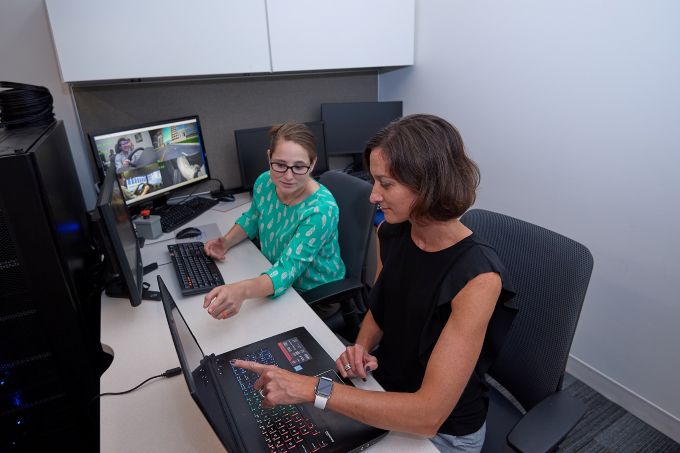

This week (October 18-24) is National Teen Driver Safety Week (NTDSW), an annual initiative to raise awareness and prevent teen injuries and deaths on the road. For this year’s NTDSW, I spoke with the authors of three recently published papers that represent the breadth of young driver research at CIRP and the strength of collaboration. Read on to learn how to know when an autistic teen is ready to drive, what driver training deserts are, and a better way to categorize eye tracking data during a virtual driving assessment.
Clinical Driver Readiness Screening for Autistic Teens
Many autistic teenagers are interested in learning to drive, and teens and their families want guidance about when to start this process. Chelsea Ward McIntosh, MS, is a clinical research study manager and a Driver Rehabilitation Professional with additional specialty in Autism. Chelsea and her team recently published a paper examining whether clinical in-office assessments used by professionals like driver rehabilitation specialists can predict whether autistic adolescents are ready to learn to drive. Chelsea says, “We found that two common in-office assessments were strongly correlated with Potential-to-Drive-Evaluations, which can help inform discussions about readiness to drive and help identify areas for development prior to beginning the driving journey.”
Paper authors also include Miriam Monaham, OTD, OTRL, CDRS (Driver Rehabilitation Institute), Laura Bennett, PhD (Department of Biomedical and Health Informatics, CHOP), Allison Curry, PhD, MPH (CIRP at CHOP, Perelman School of Medicine, University of Pennsylvania), and Emma Sartin, PhD, MPH (University of Alabama at Birmingham). This research was supported by the Eagles Autism Foundation.
Driver Training Deserts
“Access to driver training can shape young people’s opportunities to develop driving skills and become safely licensed,” says Jasmine Wu, a PhD Candidate in the Department of City and Regional Planning at the University of Pennsylvania and a CIRP Research Trainee. CIRP has a long-standing collaboration with the Ohio Traffic Safety Office on young driver safety and training. Through this collaboration, Jasmine and her team have coined the term “driver training deserts” to refer to places with substantial geographic and financial disparities in access to driver training schools across Ohio.
According to Jasmine, communities in driver training deserts were less likely to see young people become licensed before age 18 under the state’s Graduated Driver Licensing system. Jasmine is most excited about translating these findings into action: “In collaboration with state partners, we have developed a decision-support mapping tool to identify ‘driver training deserts’ and help agencies target resources to communities with the greatest needs.”
The paper includes Jasmine’s colleagues Xiaoxia Dong, PhD, BCP, and Megan Ryerson, PhD, at the Department of City and Regional Planning at the University of Pennsylvania, and Elizabeth Walshe, PhD, and Flaura Winston, MD, PhD, at CHOP. This research was supported by the U.S. National Highway Traffic Safety Administration through the Ohio Traffic Safety Office and the Ohio Department of Public Safety.
A Better Way to Measure Situational Awareness During Driving
Situational awareness is essential to safe driving, yet measurement of its key component, visual search strategy, relies on labor-intensive video coding. Thomas Seacrist, PhD, a Research Scientist and the Director of Training at CIRP, is working on a better way to measure visual search strategy using machine learning.
In a recent study, Tom and his colleagues developed a novel machine learning approach that analyzes raw eye-tracking data in the virtual driving assessment to identify how drivers search the environment without time-consuming manual video review. Tom says, “By making eye-tracking analysis more scalable, this method could help researchers better understand hazard anticipation, driving skill development, and crash risk in larger populations.”
Paper authors include David Grethlen, PhD, Megan Ryerson, PhD, Elizabeth Walshe, PhD, and Flaura Winston, MD, PhD. This research is supported by a gift from NJM Insurance Group, Flaura Winston’s Distinguished Endowed Chair in the Department of Pediatrics at the Children’s Hospital of Philadelphia, and the Annenberg Public Policy Center at the University of Pennsylvania.
Beyond National Teen Driving Safety Week
Together, these studies show how research can help address young driver safety from multiple angles, from determining readiness to drive and improving access to training to developing better ways to understand driving behavior. During National Teen Driver Safety Week and throughout the year, this work helps build the evidence needed to support young drivers as they learn, gain experience, and become safer on the road. For a full list of CIRP’s young driver safety research, please visit our website. For CIRP’s dedicated website to support families with free teen driver safety information, check out teendriversource.research.chop.edu.